
Tssst... , i'll be on your lap when I decide! 

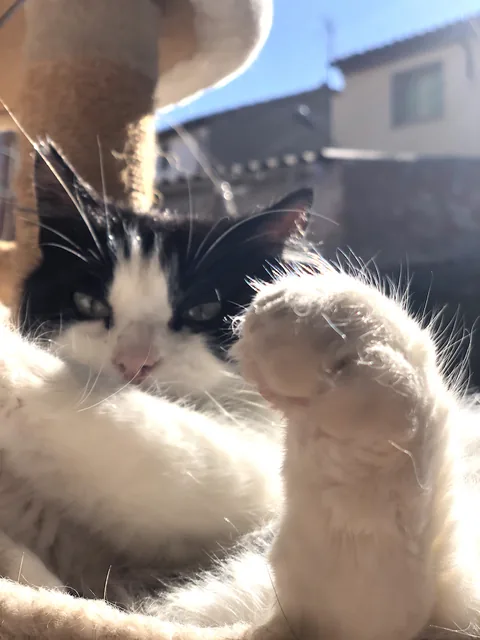
Pandy
Female · Adult (about 7 years) · Tuxedo
Adoption fee: €180
Read the adoption requirements
Sharing your home with another cat? Get a step-by-step plan for introducing your cats.
favourite thing: Playful, sass and cuddly fluff.
Health checklist
- Microchipped — not yet
- Vaccinated — not yet
- Spayed / neutered
- Dewormed
- Tested & health-checked
Pandy's story
If there is a definition of what a cat is Pandy, certainely fits it. She was always that cat who decides when, what and how. And if you go with it, she is the best kitty in the world.
That also means, she gets to decide who plays with her and how. No matter how understanding she may look at first, in the end she'll get it her way. And so, beware of the claws underneatht the fluff.
As per this type of house she is perfect. She'll simply signal that she needs something and that can be a hair-do.. She loves that. You can even tream her belly for a cooler summer styling, she'll participate gladly!
In all the years here she has been zero problems. And she seems to be able to adapt everywhere.
For the record Pandy and sis where living around a house who somewhat took care of the litter when the catmom left them. But those hoomans left and so I took care of the food. Maybe a month after, Pandy found where I lived and she simply came in and sat at the office chair. .... her sister followed her. May this brief chapter tells a lot about the determination of Pandy.
on camera
Watch Pandy
Read the story
His Majesty would like to order from your plate. Politely decline. Here are ten foods a cat must never eat.
Ten: onions, garlic, chives and leeks. Raw, cooked or powdered, they damage red blood cells. Yes, even in the gravy.
Nine: chocolate. And the darker it is, the worse it gets.
Eight: coffee, tea and energy drinks. A caffeinated cat is not a productive cat.
Seven: alcohol. Even a small amount can be deadly. The king does not do happy hour.
Six: grapes and raisins. Nobody knows exactly why they're dangerous. So let's not find out with your cat.
Five: raw bread dough. It keeps on rising… inside the stomach.
Four: milk. Most adult cats can't digest it. Cartoons lied to you.
Three: raw meat, raw fish and raw eggs. They can carry bacteria like salmonella.
Two: cooked bones and fat trimmings. Bones can splinter, and fat can upset the stomach badly.
And number one: salty snacks. Crisps are for humans with regrets.
Plus a bonus that isn't food at all: never give your cat paracetamol, or any human painkiller. For cats, it can be fatal.
If your cat eats something on this list, call your vet straight away, and take the packaging with you.
His Majesty will now be having… cat food. Again. Thrilled.
Read the story
Somewhere, right now, a parasite is planning a trip. Let's draw its map.
Cat parasites come in three kinds. Worms, which a dewormer can kill. Protozoa, tiny single cells, which need a vet. And the hitchhikers on the outside: fleas, ticks, mites and sandflies.
Here's the roundworm's round trip. Eggs leave in the poo. A few weeks later, they're ready. A mouse eats them, the cat eats the mouse… or a person with dirty hands or unwashed vegetables swallows them instead.
Because yes, some parasites reach people. Through litter trays and dirty hands. Bare feet on soil. Raw meat. Unwashed vegetables. Even a swallowed flea. And you don't need a cat to catch some of them.
In Spain, there's one more. Leishmania, spread by sandflies, from dusk to dawn, in the warm months. And never, ever use a dog's flea product on a cat. It can kill them.
Tino learned the hard way. Giardia and coccidia: two stubborn protozoa, and not a single worm. Two months of treatment, and a fibre-rich diet to rebuild his gut.
So, how often should you deworm? Kittens: often. Indoor cats: once or twice a year. Outdoor hunters: four to twelve times. Not sure? At least four.
His Majesty has reviewed this film. He tolerates it. Under protest.